
Reviewed · NEW ORLEANS BIKE TOURS
The Original ‘Creole and Crescent’ Bike Tour
New Orleans reveals itself best when you leave the French Quarter behind. This 2 to 3 hour ride follows Esplanade Avenue to City Park, then loops through Bayou St. John, Tremé, Armstrong Park, and Congo Square, linking grand homes, old oaks, music, burial customs, and local neighborhoods.
I like the small maximum of 12 riders, which makes it easier to hear the guide and ride as a group. I also like the personal feel: guides such as Teddy and Laura bring humor, local recommendations, and careful attention to safety. The main drawback is that the route covers a lot, so some stops are brief and the ride may feel short if you want long visits at each sight.
Key points to know before you book
- A 4-mile ride along Esplanade Avenue takes you past old Creole mansions and the former Millionaires Row.
- City Park and Bayou St. John bring quiet oak groves and a welcome break from the crowded French Quarter.
- Tremé, Congo Square, and Armstrong Park connect the city’s neighborhood life with the roots of jazz.
- St. Louis Cemetery No. 3 is a short stop for burial customs, photos, and a stroll, not a full cemetery tour.
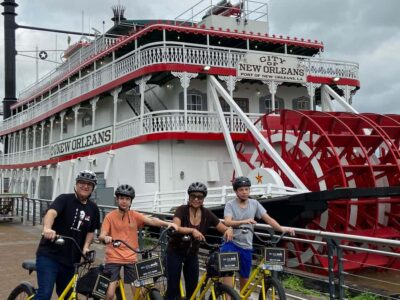
- The group is limited to 12 people, and the price includes a bicycle, helmet, handlebar bag, bell, bottled water, and rain ponchos.
- You need to ride a bike comfortably, and the tour requires moderate physical fitness.
Why this bike ride shows you more than the French Quarter
The French Quarter is the natural starting point, but it is only one piece of New Orleans. FreeWheelin Bike Tours begins at 317 Burgundy Street, where you get set up with a bicycle, helmet, handlebar bag, and bell.
From there, you ride into a much broader picture of the city. The route links the old French Quarter with Esplanade Avenue, City Park, Bayou St. John, Tremé, and Congo Square. That matters because New Orleans culture did not grow inside one tourist district. It developed through neighborhoods, waterways, family connections, music, religion, food, and complicated social history.
I like the way the route changes character as it goes. You begin among the close-set streets of the Quarter, move onto a long avenue lined with historic homes, pass beneath old live oaks, follow the bayou, and end near places tied to jazz and African American history.
The company has operated since 2011 and keeps the group size to no more than 12 riders. That is a useful balance. You still get the energy of a small group, but the guide can keep an eye on the riders and answer questions without shouting across a crowd.
The published score is 4.9 from 67 ratings, with 99 percent recommending the experience. That lines up with the strongest parts of the ride: guides such as Teddy and Laura are praised for being friendly, funny, clear, and serious about safety. One especially useful detail is that the tour has worked well for a mixed-age group, including a 67-year-old mother and an 11-year-old daughter.
More bike tours in New Orleans:
- New Orleans French Quarter and Garden District Bike Tour
★ 5.0 · 410 reviews - New Orleans Creole Odyssey Small-Group Bike Tour
★ 5.0 · 268 reviews - Creole New Orleans Electric Bike Tour (ages 16 & up)
★ 5.0 · 230 reviews
Starting in the French Quarter at Burgundy Street
The French Quarter meeting point at 317 Burgundy Street puts you close to the district’s dense historic core. You begin with a short orientation and then pedal out toward Esplanade Avenue.
This opening portion is not designed as a long French Quarter walking tour. Instead, it gets you moving and places the Quarter in context. You see it as the starting point of a larger city rather than the whole destination.
That distinction is important when choosing this tour. If your main goal is to hear detailed stories about individual French Quarter buildings, a walking tour may give you more time in each block. If you want to connect the Quarter with the neighborhoods beyond it, the bicycle is the better tool.
A bike also lets the route cover ground without turning into a bus excursion. You remain close to the street, but you can reach places that would take a long walk from the Quarter.
Esplanade Avenue and the old Creole elite
Esplanade Avenue is one of the most rewarding sections of the ride. The route follows more than four miles of the avenue toward City Park, passing grand homes associated with old Creole families and New Orleans society.
The guide explains who lived along this corridor and how those families shaped the city. This is where the ride gains depth. You are not simply looking at attractive architecture. You are hearing how wealth, family background, and local power influenced New Orleans culture.
The avenue is also known as the Avenue of the Creoles and Millionaires Row. Those names tell you what to expect: a long, formal stretch with a very different feel from the narrow Quarter streets.
A stop at Gayerre Place adds a small public-art and civic-history detail. You see the monument Peace, the Genius of History, then continue toward City Park.
The tradeoff is time. Four miles sounds substantial, but the guide must keep the group moving while also stopping for stories. You get a strong overview rather than a house-by-house architectural study.
Frenchmen Street and the shift to local music
The short stop at Frenchmen Street is a useful bridge between historic neighborhoods and modern New Orleans music. It is often described as the locals’ alternative to Bourbon Street and is closely tied to the city’s live music scene.
You should not expect a full evening of music during this stop. It is a quick look at the street and its place in the city’s nightlife. Still, it helps explain why music is not a separate attraction in New Orleans. It is woven into the city’s streets, clubs, neighborhoods, and public spaces.
This is one of several brief stops that give the ride its broad reach. If you want to linger, take photos, or visit a club, save that for later and return on your own.
A different side of New Orleans for another evening:
- New Orleans Premier Ghost, Voodoo and Vampire Walking Tour
★ 4.5 · 12,856 reviews - New Orleans Steamboat Natchez Jazz Cruise with Dinner Option
★ 4.0 · 7,533 reviews - Adults-Only New Orleans Ghost, Crime, Voodoo, and Vampire Tour
★ 5.0 · 6,545 reviews - New Orleans Food Walking Tour of the French Quarter with Small-Group Option
★ 5.0 · 6,118 reviews
City Park beneath ancient live oaks
City Park changes the pace. The ride passes through a grove of live oak trees, including a tree described as roughly 1,000 years old. The shade and open space make this a pleasant pause after the long stretch along Esplanade Avenue.
The guide also tells stories of duels and tragedies connected with the park. That contrast is part of the appeal. City Park may look peaceful, but the stories attached to it remind you that New Orleans history is rarely simple or tidy.
This section is more than a scenic break. It gives you room to understand how the city uses its public spaces and how old natural features can remain part of modern New Orleans.
After leaving the park, you cross Bayou St. John on Magnolia Bridge. The crossing marks a clear change in the route. From here, you begin following the water and entering neighborhoods that feel less like a sightseeing corridor.
Bayou St. John and Ursuline Avenue
Bayou St. John is one of the most pleasant stretches of the ride. You follow the bayou for a while before turning into the neighborhood that shares its name.
The stop on tree-lined Ursuline Avenue is designed for another history lesson in a calm setting. I like this part because it gives the tour breathing room. You are still close to central New Orleans, but the setting feels less hurried than the Quarter.
The bayou also helps you understand the city’s geography. Water has always shaped New Orleans, from settlement patterns to transport and neighborhood identity. Seeing the route from a bicycle makes that connection easy to grasp.
The ride is not presented as a strenuous athletic outing, but it is still a real bike ride. You should be comfortable riding for a few hours and handling city streets. Moderate physical fitness is required, and the tour is not suitable for someone who cannot ride a bike.
Entering Tremé beyond the usual screen version
The Tremé portion is one of the most distinctive parts of the route. The tour goes farther into the neighborhood than a quick pass along its edges, with the stated aim of showing Tremé as a lived-in community rather than a simplified version shaped by television.
That does not mean you should treat the neighborhood as a stage set. The value is in seeing streets where people live and in hearing local connections from guides who have relationships in the area. You may receive friendly greetings as the group rides through, which gives the stop a more personal feel than a standard sightseeing loop.
The guide leads the group toward Armstrong Park and Congo Square. This section also requires good riding manners. You are moving through a neighborhood, not just checking off attractions, so staying together and listening to the guide’s safety instructions matters.
For me, this is where the tour’s local focus is strongest. The route does not stop at the most polished or familiar version of New Orleans. It includes places that help explain the city’s social and musical identity.
St. Louis Cemetery No. 3 and New Orleans burial customs
At St. Louis Cemetery No. 3, the group pauses to hear about the burial process used by New Orleanians. The stop lasts about 10 minutes and is intended for stories, photographs, and a short walk among the tombs.
Keep your expectations clear: this is not a full cemetery tour. If you want detailed explanations of individual tombs, family names, or cemetery architecture, you will need a separate visit.
Even as a short stop, it adds an important piece of local culture. New Orleans burial practices are closely connected with the city’s environment, traditions, and religious life. The guide uses the cemetery to explain those customs rather than simply treating it as a photo backdrop.
The brief format also helps the overall route stay within two to three hours. You get a taste of the subject without losing the broader neighborhood ride.
Armstrong Park and Congo Square, where the route comes together
Louis Armstrong Park provides a peaceful final ride through tree-lined paths and ponds. It is a gentle way to finish the circuit before reaching Congo Square.
Congo Square is the most meaningful endpoint on the route. It is presented as the birthplace of jazz music and a source for the traditions connected with Jazz Fest. The stop brings together many of the themes introduced earlier: African American culture, public gathering spaces, rhythm, local identity, and the long development of New Orleans music.
This final stop gives the tour a strong sense of purpose. You began with architecture and city streets, but you finish with the cultural forces that made New Orleans famous around the world.
The route then returns to the French Quarter meeting point. You do not need to arrange a separate ride back from another neighborhood, which is helpful if you have dinner plans or another activity afterward.
What the $55 price really covers
At $55 per person, the tour is reasonably priced for a small-group experience lasting two to three hours. The fee includes the bicycle, helmet, handlebar bag, bell, bottled water, and complimentary ponchos if rain arrives.
The real value is the amount of ground covered with a guide. Walking the same route would take much longer, and a larger vehicle would lose the street-level feel. You are paying for transportation, interpretation, local orientation, and a planned route through several parts of New Orleans.
The price is less compelling if you want a long stop at every location. Some pauses last only five or 10 minutes, and one rider specifically wished for a longer ride with more stops. That is a fair criticism. The tour favors range and variety over extended visits.
Tips are not included. If your guide keeps the ride safe, explains the city clearly, and gives you useful suggestions for the rest of your stay, plan to tip separately.
Safety, weather, and practical planning
The tour uses a mobile ticket, and confirmation is provided at booking. You meet and finish at FreeWheelin Bike Tours and Rentals on Burgundy Street.
Wear comfortable clothing and shoes suitable for several hours on a bicycle. Bring a way to protect your phone and camera, though the handlebar bag gives you some storage. Bottled water is supplied, and rain ponchos are available if the weather turns wet.
The experience requires good weather. If poor weather forces a cancellation, you are offered another date or a full refund. If the minimum number of riders is not reached, you receive the same choice of a new date or a full refund.
The standard cancellation rule is strict: the booking is non-refundable and cannot be changed for personal reasons. Check your schedule before paying, especially since the tour is often booked about 35 days ahead.
The group limit of 12 is a major practical plus. It gives the guide a better chance to keep riders together and makes it easier for you to hear stories at stops. Guides including Teddy and Laura have been praised for mixing humor with clear safety direction.
Who will enjoy this New Orleans bike tour most?
I would choose this ride if you want an overview that reaches well beyond the French Quarter. It suits you if you enjoy local stories, historic architecture, neighborhood scenery, music history, and a moderate amount of physical activity.
It is also a good fit for families with older children and adults who can ride comfortably. The experience has worked for a mixed-age group, but every rider must be able to handle a bicycle.
You may want another option if you dislike riding in city traffic, need long breaks, or prefer to spend an hour at each attraction. The route is active and fairly broad. Its strength is connection, not extended time at one site.
Should you book the Original Creole and Crescent Bike Tour?
Book it if you want to understand how the French Quarter connects to the rest of New Orleans. The route gives you old homes on Esplanade Avenue, ancient oaks in City Park, Bayou St. John, Tremé, a cemetery stop, Armstrong Park, and Congo Square in one manageable outing.
I especially like the combination of small-group riding and local storytelling. Guides such as Teddy and Laura add the human touch, while the route itself gives you a useful map of the city.
Skip it if your priority is a slow, highly detailed tour of one district. For most visitors who can ride a bike and want more than Bourbon Street, $55 is a fair price for the distance, context, equipment, and personal guidance.
FAQ
Where does the bike tour start and finish?
The tour starts and ends at FreeWheelin Bike Tours and Rentals, 317 Burgundy Street, New Orleans, Louisiana 70112.
How long does the tour last?
The ride lasts approximately two to three hours.
How many people can join the tour?
The maximum group size is 12 riders.
What is included in the price?
The price includes use of a bicycle, bottled water, a helmet, handlebar bag, bell, and complimentary ponchos for rainy weather.
Do I need to know how to ride a bike?
Yes. You should be able to ride a bike and have a moderate physical fitness level. The tour is not recommended for anyone who cannot ride.
What happens if bad weather cancels the tour?
If poor weather causes a cancellation, you are offered a different date or a full refund.
Newest New Orleans tours we have written up
- New Orleans : Garden District Architecture Walking tour★ 4.8 · 5 reviews
- Ultimate Denver Day Out: Red Rocks, City Views & Ice Cream★ 5.0 · 7 reviews
- From New Orleans: Whitney and Laura Guided Plantation Tour★ 4.9 · 20 reviews
- Whitney Plantation and Soul of New Orleans City Tour Combo★ 5.0 · 13 reviews
- Treme Bar Crawl & Seafood Experience★ 4.2 · 7 reviews
- True Voodoo History of NOLA’s Congo Square with Local Guide★ 4.9 · 16 reviews
- Whitney Plantation Tour with Transportation★ 4.0 · 29 reviews
- Witches Coven Walking Tour in New Orleans★ 5.0 · 49 reviews
New Orleans Bike Tours, compared.
New Orleans French Quarter and Garden District Bike Tour
Read our review →
New Orleans Creole Odyssey Small-Group Bike Tour
Read our review →
Creole New Orleans Electric Bike Tour (ages 16 & up)
Read our review →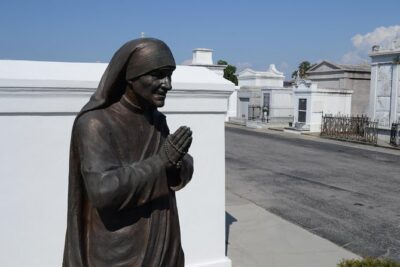
New Orleans History and Sightseeing Small-Group Bike Tour
Read our review →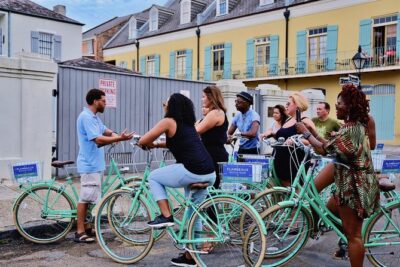
New Orleans Garden District and Cemetery Bike Tour
Read our review →
Browse the lists this tour appears in