
Reviewed · NEW ORLEANS FRENCH QUARTER TOURS
New Orleans French Quarter and More Carriage Ride
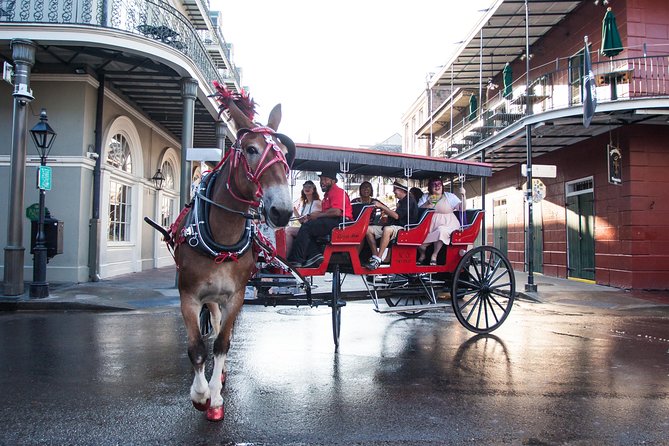
A mule-drawn carriage is a fine way to get your first look at New Orleans. You roll along at a slow pace through the French Quarter and Marigny while your guide points out iron balconies, Creole buildings, old courtyards, churches, markets, and places tied to the city’s long, often complicated past.
I like the small group of no more than eight and the relaxed pace. I also like that the guide does more than name buildings, offering suggestions for restaurants, jazz clubs, museums, nightspots, and places to visit later. The main drawback is that one hour goes quickly, and the carriage seats can feel uncomfortable or slightly sloped when the carriage pulls toward the curb.
Key points to know before booking
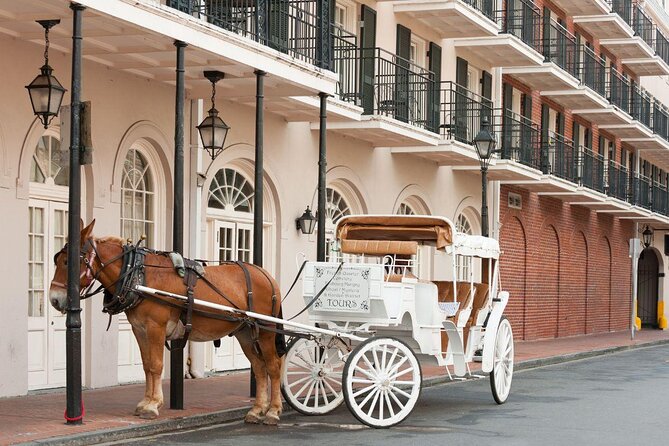
- A calm first look at New Orleans: The carriage gives you a useful overview before you spend the rest of your visit on foot.
- The route covers major French Quarter sights: Expect St. Louis Cathedral, Place d’Armes, the Cabildo, French Market, Napoleon House, and the Pontalba Buildings.
- The group is capped at eight people: That makes it easier to hear the guide and ask questions.
- The carriage has a covered top: You get shade and some protection from difficult weather, though the experience still depends on safe riding conditions.
- Guides add personal flavor: Names appearing in the experience include Sarah, Nate, Marty, Tony, Trish, Mike, and others, with each guide bringing a slightly different set of stories.
- It ends where it begins: The meeting point is 700 Decatur Street, leaving you in the middle of the French Quarter with the rest of your day free.
Why a carriage ride works well for a first visit
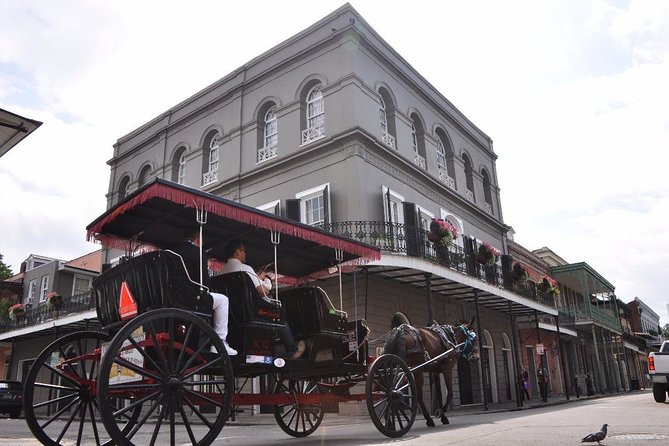
New Orleans can be hard to read on your first day. Streets turn, buildings change style, and a short walk may take you past ten places you do not yet understand. A carriage ride gives you a simple framework.
You sit back while the mule handles the pace and the guide explains what you are seeing. This is less tiring than a long walking tour, especially if you have limited stamina or are traveling with a young child. One family found that a four-year-old was fascinated by the mule, while another rider valued the ride because walking long distances was difficult.
The experience is also useful for planning. Listen for the places your guide recommends, then return later for a meal, a museum visit, live music, or a closer look at a building. The ride is not designed to replace every walking tour or museum. It is a pleasant introduction that helps you decide what deserves more time.
At $65 per person, the price is not cheap for an hour. You are paying for the carriage, the mule, the driver-guide, and a small group rather than for admission to an attraction. I think the cost makes the most sense on your first day, when orientation and local suggestions have real value. If you already know the French Quarter well, a standard walk may give you more detail for less money.
More French Quarter tours in New Orleans:
- New Orleans Food Walking Tour of the French Quarter with Small-Group Option
★ 5.0 · 6,118 reviews - New Orleans French Quarter, Voodoo and Culture Walking Tour
★ 4.5 · 2,961 reviews - French Quarter Historical Sights and Stories Walking Tour
★ 5.0 · 2,724 reviews
Meeting at 700 Decatur Street
The tour begins at 700 Decatur Street, a central location near the French Quarter’s main sights. You return to the same place at the end, so you do not need to arrange a separate ride back to your hotel or another neighborhood.
Plan to arrive with enough time to find the designated carriage meeting area. The activity is offered in English, and confirmation is provided when you book. It is near public transportation, and service animals are allowed.
The group limit is eight people. That matters here. A carriage ride is much easier to enjoy when the guide’s voice reaches the back and you are not packed into a large vehicle. If you have trouble hearing, sit toward the front when possible. One rider specifically found the narration harder to catch from the back.
Rolling past St. Louis Cathedral and Place d’Armes
The French Quarter portion is the heart of the ride. The neighborhood is also called the Vieux Carré, and your guide uses its buildings and streets to explain how New Orleans developed under French and Spanish influence.
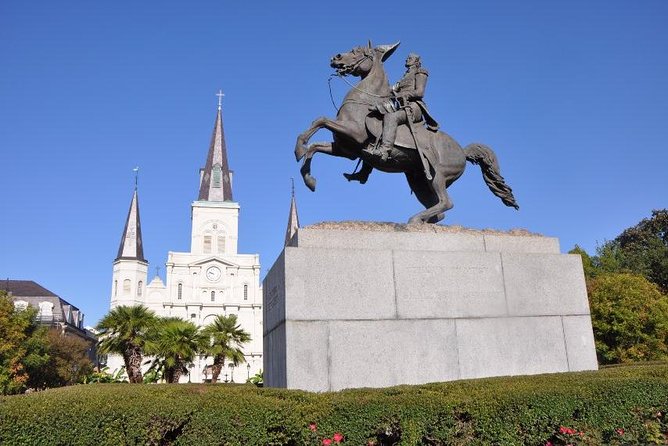
St. Louis Cathedral is one of the key sights. It is the oldest continuously active cathedral in the United States, and its position beside Jackson Square gives it a strong visual presence. From a carriage, you get a broad view of the cathedral and surrounding buildings rather than an interior visit, so plan a separate stop if you want to go inside.
Place d’Armes anchors the area around the cathedral. The square and its neighboring buildings help show the formal side of the Quarter, with a layout that feels different from the narrow, irregular streets nearby. This is a good place to pay attention to your guide’s comments about architecture and city planning.
The Spanish Cabildo is another major landmark on the route. Its Spanish colonial design reflects a period when New Orleans was shaped by Spanish rule as well as French beginnings. The ride gives you context from the street, but admission inside is not part of this experience.
French Market, the Mississippi, and old city commerce
The route also reaches the French Market area overlooking the Mississippi. This is one of the places where New Orleans’ location becomes clear. The city’s life has always been tied to the river, trade, food, and movement, and the market area helps connect those themes.
Do not expect a full market visit during the ride. The carriage passes through the area as part of a broader circuit, so you will have only a short view and commentary. I would treat this as a scouting stop. If the market catches your attention, return later when you can walk, browse, and eat at your own pace.
The same goes for the French coffeehouses and other commercial buildings pointed out along the way. The value is in learning where they are and why they matter, then deciding which ones deserve a closer look.
More carriage rides in New Orleans:
- New Orleans Small-Group Haunted History Carriage Tour
★ 4.5 · 2,289 reviews - New Orleans: French Quarter Sightseeing Carriage Ride
★ 4.7 · 644 reviews - New Orleans Private Carriage Tour of the French Quarter
★ 5.0 · 537 reviews
Napoleon House and the Pontalba Buildings
Napoleon House adds one of the ride’s more unusual historical details. The building is connected with a mold made by Dr. Francesco Antommarchi, one of Napoleon Bonaparte’s physicians at the time of Napoleon’s death. The site is now associated with Napoleon’s death mask.
You will hear the story from outside as the carriage passes. It is the sort of detail that makes the Quarter easier to remember because it links a familiar building to an unexpected international connection. If you are interested in the site, return later rather than expecting a museum visit during the carriage ride.
The Pontalba Buildings offer a different lesson. They are often described as the oldest apartment buildings in the United States. Their long, elegant facades and ironwork help explain why balconies are such a defining feature of the Quarter.
Look closely as you ride. New Orleans architecture is not only about grand buildings. Your guide may point out Spanish patios, iron balconies, Creole Esplanade-style homes, and former quarters connected to the city’s history of slavery. The carriage pace gives you time to look upward, which is useful in a neighborhood where many of the best details sit above street level.
Stories of fire, flood, and changing architecture
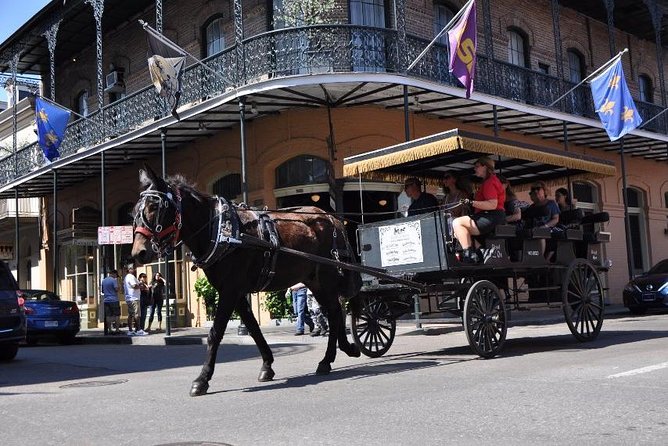
The commentary is strongest when it connects the buildings to events. The Great Fire of 1788 and the Battle of New Orleans are among the subjects included in the tour.
The fire helps explain why so many parts of the French Quarter are built with brick and framed by iron. The city’s floods and other weather threats also shaped construction choices. Guides such as Marty have been praised for explaining how fire and flooding influenced the materials you see today.
This is not a specialist architecture seminar. The information comes in short stories as the carriage moves, and the depth can depend on the guide and the day’s conditions. Some guides focus heavily on facts, while others add ghost stories, restaurant tales, and personal observations. If you want more detail, ask questions as you go.
The carriage is not always quiet. Traffic, street noise, and the position of your seat can affect how clearly you hear the narration. That is another reason to sit near the front if the guide’s stories are a major reason you booked.
A look beyond the Quarter toward Marigny
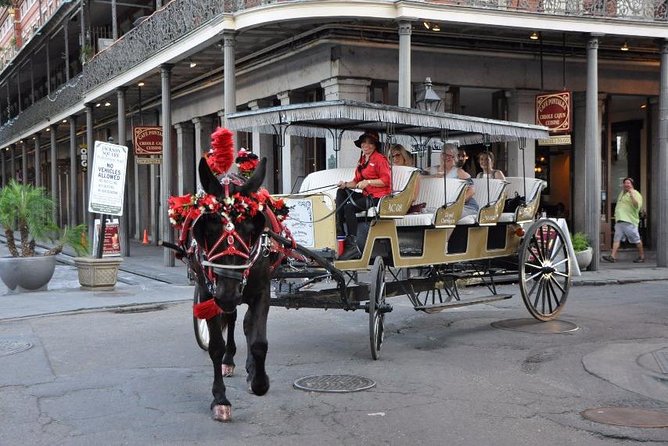
The experience is described as covering both the French Quarter and Marigny. That gives you a wider view than a short loop around Jackson Square and Decatur Street.
The Marigny area helps show how New Orleans continues beyond its best-known historic core. You may see colorful homes and distinctive architecture that you would not notice if you stayed only near the cathedral and riverfront. One rider especially liked seeing vivid house colors and learning why the homes were painted as they were.
Keep your expectations measured. The tour lasts about one hour, so this is an overview, not a street-by-street tour of Marigny. The route can also be affected by traffic and road conditions. Still, seeing the neighborhood from a carriage helps you spot places to revisit on foot.
The carriage, mule, and comfort level
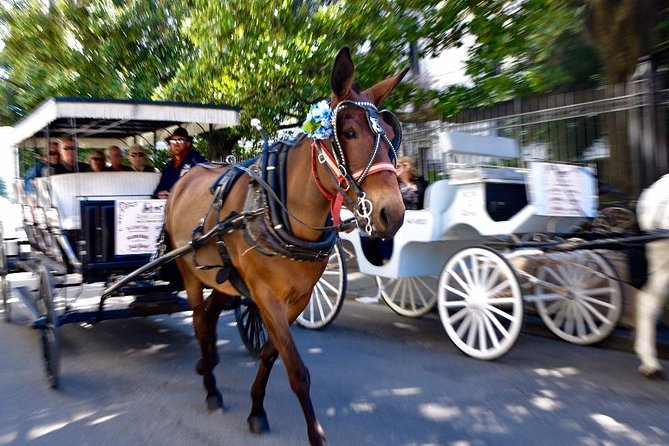
The ride uses a mule-drawn carriage with a covered top. The cover provides shade and some shelter from difficult weather, making the pace more pleasant than walking under strong sun.
Several practical details affect comfort. The ride is generally smooth, but the seats may feel hard after a while. When the carriage pulls toward the curb to let traffic pass, the road’s slope can make you slide slightly in that direction. This is not a major problem for most people, but it is worth knowing if you have back, balance, or mobility concerns.
The experience is not a private carriage ride. You share the carriage with the rest of your small group, and a rescheduled group after rain can make the carriage feel fuller. The usual maximum is eight people, which keeps the setup manageable.
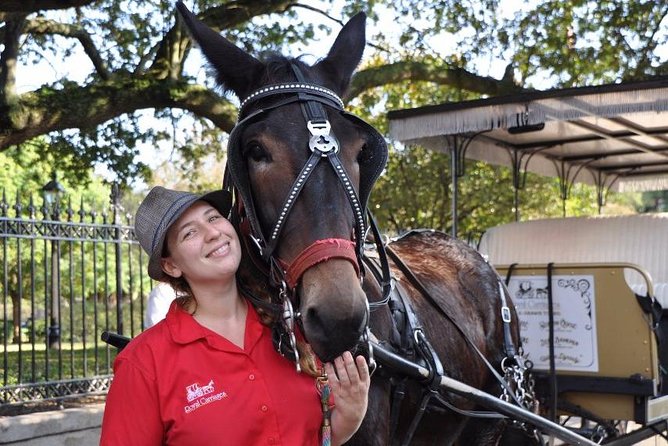
The mule is part of the appeal, especially for children. Guides often introduce the animal by name, and individual teams vary. Tony, for example, has been paired with a mule named Praline, while Marty has driven with Kate. The animal adds character, but the real purpose is the slow, steady ride and the chance to see the city without rushing.
What the guides add
The guide can make or break a carriage ride. The strongest guides combine local knowledge with a clear speaking voice and a relaxed manner.
Sarah is noted for offering fun historical details and practical advice. Nate is associated with an informative approach that covers the Quarter’s past and points out places to visit. Marty has a reputation for explaining fire, floods, architecture, and local stories, while Tony has been described as funny and full of French Quarter facts.
You may also encounter Trish or Mike, among other guides. The exact personality and subject mix will vary. One guide may spend more time on architecture, another on ghost stories or restaurants. That variation is part of the charm, though it means you should not expect a scripted performance with exactly the same commentary each time.
The best use of the guide is to ask for suggestions that match your interests. Ask about jazz clubs if you want music, museums if you want more history, or restaurants if you are planning dinner. The included recommendations are a practical part of the experience, not just an extra line in the description.
Who should book this ride?
I would choose this carriage ride for a first visit to New Orleans, families with a young child, couples wanting a quiet hour, and anyone who prefers not to walk long distances. It also works well early in a trip because you can use the guide’s suggestions to shape the days that follow.
It suits people who enjoy architecture, local stories, and a gentle pace. The covered carriage and small group add comfort, and the return to Decatur Street makes the ride easy to fit around other plans.
I would choose something else if you want a long, detailed history lecture, inside visits to landmarks, or a close look at a specific museum. You might also prefer a walking tour if you want to stop often for photographs or explore narrow side streets at ground level.
Book ahead if your schedule is fixed. The ride is often reserved about 22 days in advance, which suggests that popular dates can fill well before arrival.
Weather, cancellation, and timing
The activity requires good weather. If poor weather forces a cancellation, you can receive a different date or a full refund. You can cancel for a full refund up to 24 hours before the start time, while cancellations or changes inside 24 hours are not refunded.
That policy makes early planning sensible, especially if you are visiting during a rainy period. The covered top helps with sun and some difficult conditions, but it does not turn the ride into an all-weather activity.
The one-hour length is a strength for many people. It is long enough to see the main sights and short enough to leave room for lunch, a museum, or an evening reservation. A few riders wished for another ten minutes, but the hour also keeps the experience from becoming tiring.
Should you book the New Orleans carriage ride?
Book it if you want a comfortable introduction to the French Quarter and Marigny, especially on your first day. The strongest reasons are the eight-person limit, the slow carriage pace, the broad set of landmarks, and the useful advice about where to eat, hear music, and explore later.
At $65, it is best viewed as an orientation tour with atmosphere rather than a bargain sightseeing ride. You will not go inside the cathedral, Cabildo, French Market, or Napoleon House, and the commentary may feel brief if you want exhaustive detail.
For most first-time visitors, I think it earns its place in the plan. Sit near the front, listen for places to return to, and treat the ride as your introduction to the city rather than your entire New Orleans history lesson.
FAQ
How long is the New Orleans French Quarter and More Carriage Ride?
The carriage ride lasts approximately one hour.
Where does the tour begin?
It begins at 700 Decatur Street, New Orleans, Louisiana 70116.
Where does the tour end?
The activity ends back at the meeting point on Decatur Street.
How many people can join the carriage ride?
The tour has a maximum of eight travelers.
Is the carriage covered?
Yes. The carriage has a covered top to provide shade and some protection from difficult weather.
Which areas does the carriage ride visit?
The experience covers the French Quarter and Marigny areas of New Orleans.
What landmarks can I see?
The route includes sights such as St. Louis Cathedral, Place d’Armes, the Spanish Cabildo, the French Market, Napoleon House, the Pontalba Buildings, and the Place d’Armes Hotel.
What is included in the price?
The price includes the mule-drawn carriage ride and recommendations for nightclubs, jazz, museums, and other New Orleans sights. Snacks and gratuity are not included.
Can I cancel for a full refund?
Yes. You must cancel at least 24 hours before the experience start time for a full refund. Cancellations or changes made less than 24 hours before the start time are not refunded.
Newest New Orleans tours we have written up
- 45-Minute Garden District Highlights Tour in New Orleans★ 5.0 · 33 reviews
- New Orleans City and Swamp Helicopter Tour★ 5.0 · 9 reviews
- 45-Minute Marigny Triangle Highlights Tour in New Orleans★ 5.0 · 12 reviews
- 20 Passenger New Orleans Airport or Hotel Transfer★ 5.0 · 6 reviews
- Private New Orleans 2-Hour Sail Aboard a Luxury Yacht★ 5.0 · 44 reviews
- The New Orleans Darkness Tour★ 4.4 · 9 reviews
- 11 Passenger Executive Van: New Orleans Airport or Hotel Transfer★ 4.0 · 8 reviews
- Spooky Family Ghost Tour★ 3.4 · 9 reviews
New Orleans French Quarter Tours, compared.
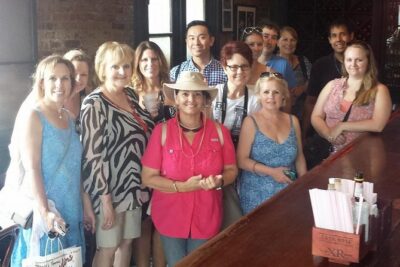
New Orleans Food Walking Tour of the French Quarter with Small-Group Option
Read our review →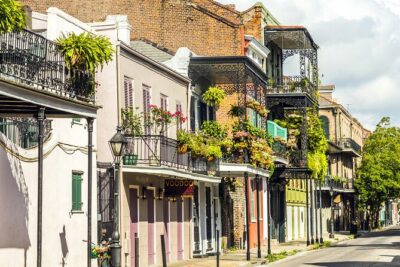
New Orleans French Quarter, Voodoo and Culture Walking Tour
Read our review →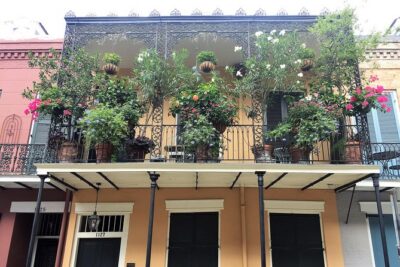
French Quarter Historical Sights and Stories Walking Tour
Read our review →
Ghost and Vampire Walking Tour Of The French Quarter
Read our review →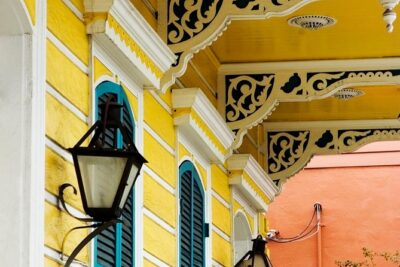
New Orleans City Tour: French Quarter, Garden District & Cemetery
Read our review →
New Orleans French Quarter Food Tour: Cajun, Creole and Culture
Read our review →
French Quarter walking Food Tour Famous Flavors of New Orleans
Read our review →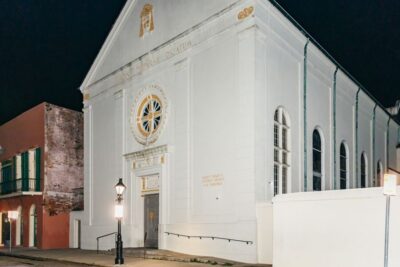
French Quarter Ghost Tour with Interior Visit
Read our review →Browse the lists this tour appears in