
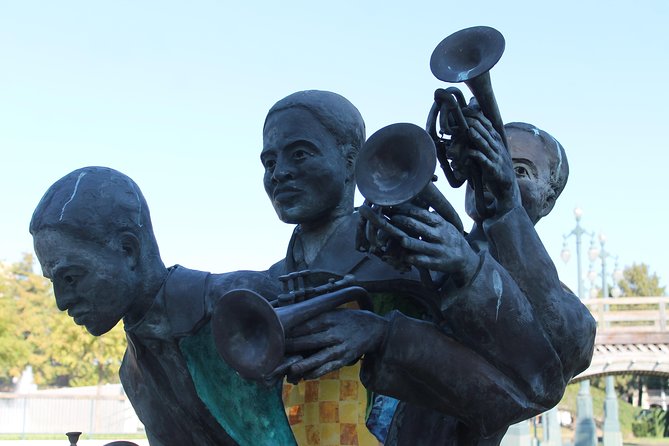
Reviewed · TREME WALKING TOURS
Walking the Tremé: A Self-guided Audio Tour of New Orleans
Tremé comes into focus through stories about church pews, Mardi Gras Indians, gospel legend Mahalia Jackson, and Louis Armstrong. This one-hour GPS audio walk gives you a close look at a New Orleans neighborhood that rewards attention more than speed.
I like the $9.99 price and the freedom to pause, wander, or replay a section. I also like the mix of music, faith, architecture, and local memory. The main catch is the technology: most of the tour works well, but some users have had trouble getting the audio or GPS to start.
Key points to know before you go
- A personal route through Tremé: The walk begins at 801 N Rampart Street and ends at Saint Augustine Catholic Church.
- Strong storytelling: The audio covers the War of the Pews, Mardi Gras Indian culture, Mahalia Jackson, and Louis Armstrong.
- Useful offline access: You can download the audio, map, and location data through the VoiceMap app.
- Good value for independent walkers: At $9.99, it costs far less than a private guided walk and gives you lifetime access.
- Take care at crossings: One part of the route has been flagged for asking walkers to cross a highway section not designed for pedestrians.
- Plan for a phone and headphones: A smartphone is required, and transportation, food, drinks, and personal expenses are not included.
Why Tremé works best with a story in your ear
Tremé is not a place you should rush through with a camera pointed at buildings. Its meaning often sits in the connection between a church, a park, a theater, a musician, and the people who kept local traditions alive.
This audio tour gives those connections a simple shape. You walk from one point to the next while the app uses your location to play the right section. You do not need to keep checking a printed map or wonder if you have reached the next stop. When the system works, the route feels easy to follow.
The narration also leaves room for the neighborhood itself. One highly praised feature is the pacing. The audio provides useful detail, then allows you time to look around rather than filling every second with talk. That matters in Tremé, where the setting is part of the lesson.
I would not treat the one-hour estimate as a strict appointment. It covers the walking and listening time, but you may want longer if you stop at a museum, pause to study a building, or replay a section. Admission fees, if required at any stop, are not part of the $9.99 cost.
More walks through the Treme:
- New Orleans Treme’ Walking Tour
★ 5.0 · 240 reviews - New Orleans: Tremé African American & Creole History Tour
★ 4.9 · 208 reviews - 60-minute Tremé Walking Tour & Photo Experience
★ 5.0 · 72 reviews
Starting at 801 N Rampart Street
Your starting point is 801 N Rampart Street. Directions to the beginning are provided, and the GPS tour is designed to start once you reach the correct location.
Before setting off, I would download the audio, map, and geodata over a reliable connection. The tour offers offline access, which is useful in theory and removes the need to depend on mobile service during the walk. Still, the app must load correctly before you begin.
This is the one practical weakness I would take seriously. One user could not get the tour past the download screen, even with full cell service. Another had such poor GPS performance that only a few audio descriptions played in the correct places. Other users reported no software trouble at all, so the problem does not appear universal, but you should test the tour before walking far from the starting point.
If the audio does not begin, check that you have redeemed the tour in the VoiceMap application and downloaded the route. That small bit of preparation can save you from standing on the corner trying to make the technology cooperate.
Saint Augustine Church and the War of the Pews
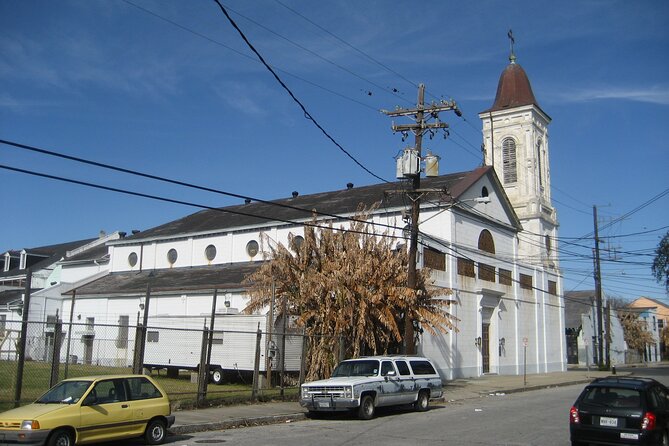
Saint Augustine Church gives the tour a powerful opening subject: a conflict over church seating that revealed the social order of New Orleans in 1842.
Creoles of color began buying pews for their families inside the church. White residents responded by launching their own effort to purchase family pews. The episode became known as the War of the Pews.
I like this story because it takes a large subject, race and social power, and places it in a very specific setting. A church pew may sound like a small matter, but the right to sit, worship, and claim a place in a public religious space carried real meaning.
Listen closely here. The point is not simply to memorize the name of the dispute. The story helps you see Saint Augustine as a place where community, faith, status, and resistance met in everyday life.
The provided route information lists Saint Augustine as the end point, but the church also features in the historical material. Since the exact sequence of every audio trigger is controlled by the app, follow the on-screen directions rather than assuming the written stop order is the walking order.
Backstreet Cultural Museum and the art of the street
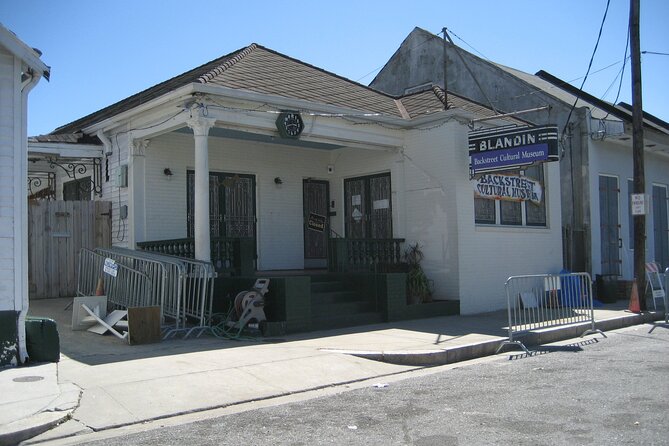
The Backstreet Cultural Museum is one of the most visually appealing stops. Its collection includes Mardi Gras Indian costumes, second line umbrellas, and photographs connected to New Orleans backstreet traditions.
The costumes are not just bright objects for a quick photo. They point toward a culture built through making, performance, neighborhood identity, and memory. The umbrellas carry their own visual language, while the photographs help connect the objects to the people and events behind them.
I would give this stop more attention than the short tour time may suggest. If the museum is open and admission applies, you may need extra time and money beyond the audio tour price. The supplied information does not provide an admission cost or confirm how long you can spend inside, so check before relying on it as a full museum visit.
Even if you only use the audio stop as an introduction, it gives you a better way to look at the displays. Instead of seeing costumes as decoration, you can consider how they record neighborhood pride and public celebration.
More self-guided audio tours in New Orleans:
- Ghosts of New Orleans: Self-Guided Haunted Audio Walking Tour
★ 4.0 · 32 reviews - Self-Guided Walking Tour French Quarter In New Orleans
★ 4.0 · 13 reviews - Self Guided Walking Tour of New Orleans’ Historic Garden District
★ 4.5 · 13 reviews - Self Guided Audio Ghost Tour in New Orleans in 6 Languages
★ 4.1 · 12 reviews
New Orleans African American Museum and Tremé homes
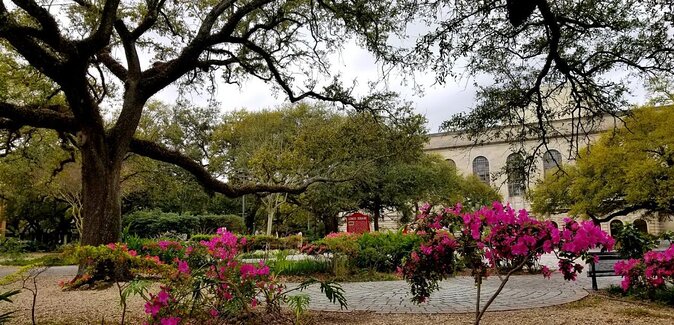
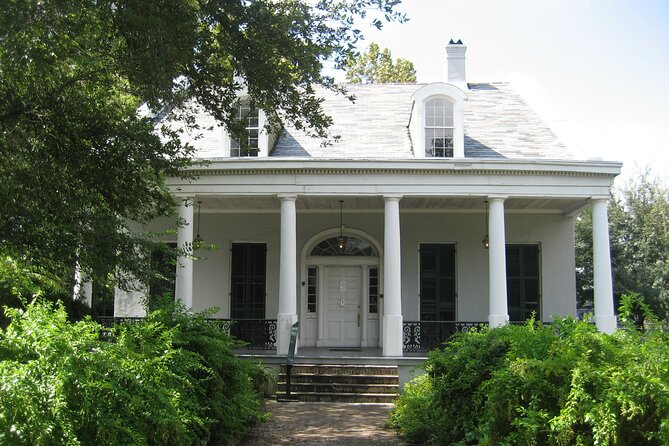
The New Orleans African American Museum is set among shaded grounds that include the original kitchen dependencies of Tremé Villa Meilleur. Several homes show different local building styles.
This stop adds architecture and domestic life to the walk. The small supporting buildings matter because they reveal how a property functioned beyond its main house. The range of homes also helps you notice that Tremé is not defined by one single building type or one frozen version of the past.
I would keep your expectations practical. The audio tour explains the setting, but it is still a self-guided walk, not a museum docent-led visit. Entry details and fees are not included in the supplied tour information. If you want to go inside, treat that as an optional addition and allow time for it.
The museum grounds also provide a useful pause in the route. After several audio sections, a quieter place to stop can help you absorb what you have heard instead of racing toward the next GPS trigger.
Mahalia Jackson Theater and the power of a local voice
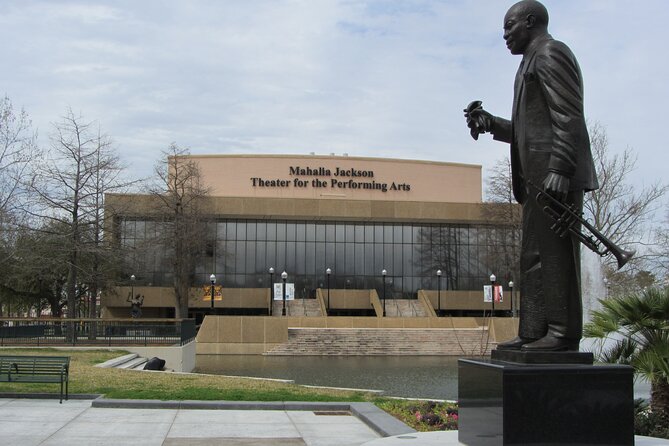
The Mahalia Jackson Theater of the Performing Arts connects Tremé to one of New Orleans’ most important gospel voices.
Mahalia Jackson became an international figure after recording the highest-selling gospel song in history, but the story keeps bringing her back to New Orleans. That local connection is the point. Her career grew far beyond the neighborhood, yet her identity remained linked to the city that shaped her.
I like the way this stop widens the tour’s frame. You are not only hearing about old buildings or past conflicts. You are also tracing how a person from New Orleans carried the city’s music onto an international stage.
The theater itself is a useful reminder that performance in New Orleans is not limited to festivals or street parades. The route places gospel, formal theater, and neighborhood culture in the same conversation.
Louis Armstrong Park and the city’s musical memory
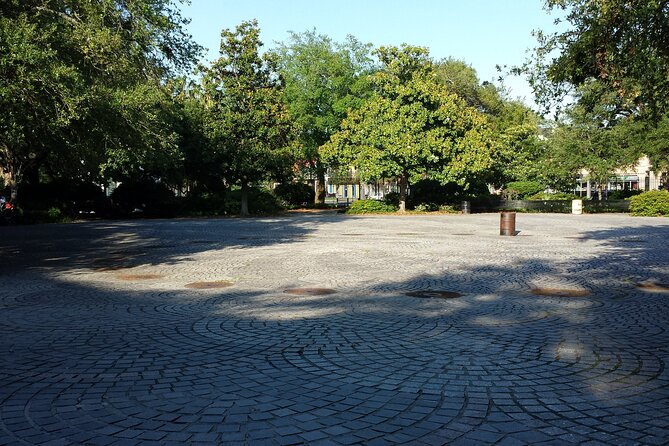
Louis Armstrong Park brings the tour to one of Tremé’s best-known public places. Armstrong was born in 1901 just outside Tremé and grew up among churchgoers, hustlers, pimps, and musicians.
That description gives you a more textured picture than a simple list of awards. Armstrong’s world included religious life, hard streets, and music. Those influences help explain why he became such an important ambassador for New Orleans.
The audio uses both of his famous nicknames, Satchmo and Pops, and places his early life close to the neighborhood you are walking through. I find that more useful than treating him as a distant celebrity. You can connect the famous name to a real place and to the people around him.
The park is also where the tour’s larger questions become harder to ignore. One critical response to the narration felt that the treatment of Tremé softened the neighborhood’s struggles and did not fully address the way residents have been shut out of parts of the park. I would keep that concern in mind. The audio offers valuable background, but you should not expect one hour of narration to represent every local viewpoint.
What the GPS format does well
A location-triggered audio tour can be a fine middle ground between wandering alone and joining a group. You get directions and a planned route, but you do not have to match a guide’s pace or listen to questions from strangers.
The strongest parts of this format are simple:
- You can stop the audio when you want.
- You can replay sections.
- You can explore at your own speed.
- You can use the map and audio offline.
- You receive lifetime access, so the tour is not limited to one listening session.
Several positive experiences focused on the narration, pacing, and easy navigation. One person specifically appreciated how the system detected their position and began the relevant story. Another found the audio easy to follow and free of glitches.
That said, GPS is not magic. Tall buildings, phone settings, a delayed location signal, or an incomplete download can affect playback. The app may also ask you to cross streets. Pay attention to the actual street conditions, not only the spoken directions.
One section has been singled out as a safety concern because it asks you to cross a highway area without a pedestrian crossing. I would not follow any instruction blindly. If a crossing feels unsafe, pause the tour and use your own judgment.
Who will get the most from this $9.99 tour?
I think this tour suits independent visitors who want context but do not want to book a fixed group walk. It also works well for solo visitors, couples, and families who can manage a phone-based route.
You will likely enjoy it most if you:
- Like history told through specific people and places.
- Prefer to pause for photos or conversation.
- Want a low-cost introduction to Tremé.
- Are comfortable using a smartphone app.
- Can download content before starting.
- Want to return to the route later because access is lifetime.
Families may appreciate the flexible pace, though adults should handle the phone and watch the route at street crossings. The tour is listed as suitable for most participants, and service animals are allowed. It is near public transportation, but transportation to and from the start is not included.
I would choose a live guide instead if you want to ask questions, discuss present-day neighborhood issues, or get a fuller range of local perspectives. The audio gives you a clear path, but it cannot respond to what you notice or explain a surprise along the way.
Price, timing, and the real value
At $9.99 per person, this is inexpensive for a one-hour introduction to Tremé. A private guide would offer more conversation and flexibility, but this tour costs far less and lets you share one route with your own group without arranging a meeting time with a person.
The value improves if you use the lifetime access. You could listen once on site, then replay the sections later. That is particularly useful if the GPS misfires or if you want to focus on the historical content after the walk.
The price does not cover a smartphone, transportation, food, drinks, museum admission, or personal expenses. Those exclusions are ordinary for a self-guided audio walk, but they matter when you compare the total cost of your outing.
The cancellation policy is simple: cancel at least 24 hours before the local start time for a full refund. Cancellations or changes inside that window are not refunded.
Should you book Walking the Tremé?
I would book it if you want a low-cost, self-paced introduction to one of New Orleans’ most important neighborhoods, and you are willing to prepare the app before leaving. The strongest material links Saint Augustine Church, Mardi Gras Indian art, African American museum sites, Mahalia Jackson, and Louis Armstrong into one walk.
I would hesitate if you need flawless technology, safe pedestrian instructions at every point, or a guide who can answer questions and address competing views of Tremé’s past and present.
For the best experience, download everything before you arrive, start with a charged phone, use your own judgment at crossings, and allow more than one hour if you plan to visit museums. At $9.99, the tour is a sensible buy for curious walkers who want structure without surrendering their freedom.
FAQ
How long does the Walking the Tremé tour take?
The tour lasts approximately one hour. You may need extra time if you pause, replay audio, visit a museum, or stop for photos.
Where does the tour start?
The starting point is 801 N Rampart Street, New Orleans, Louisiana 70116.
Where does the tour end?
The listed end point is Saint Augustine Catholic Church at 1210 Governor Nicholls Street, New Orleans, Louisiana 70116.
What language is the tour offered in?
The tour is offered in English.
Do I need a smartphone?
Yes. A smartphone is not included. You use the VoiceMap application to access the audio, map, and geodata.
Can I cancel for a full refund?
Yes. You can receive a full refund if you cancel at least 24 hours before the experience start time. Cancellations or changes made less than 24 hours before the start time are not refunded.
More Walking Tours in New Orleans
- New Orleans Premier Ghost, Voodoo and Vampire Walking Tour
★ 4.5 · 12,856 reviews - New Orleans Food Walking Tour of the French Quarter with Small-Group Option
★ 5.0 · 6,118 reviews - St. Louis Cemetery No. 1 Official Walking Tour
★ 4.5 · 3,941 reviews - New Orleans French Quarter, Voodoo and Culture Walking Tour
★ 4.5 · 2,961 reviews
Newest New Orleans tours we have written up
- 45-Minute Garden District Highlights Tour in New Orleans★ 5.0 · 33 reviews
- New Orleans City and Swamp Helicopter Tour★ 5.0 · 9 reviews
- 45-Minute Marigny Triangle Highlights Tour in New Orleans★ 5.0 · 12 reviews
- Private New Orleans 2-Hour Sail Aboard a Luxury Yacht★ 5.0 · 44 reviews
- 20 Passenger New Orleans Airport or Hotel Transfer★ 5.0 · 6 reviews
- The New Orleans Darkness Tour★ 4.4 · 9 reviews
- 11 Passenger Executive Van: New Orleans Airport or Hotel Transfer★ 4.0 · 8 reviews
- Spooky Family Ghost Tour★ 3.4 · 9 reviews
Treme Walking Tours, compared.


New Orleans Voodoo, Storyville, Treme, Walking Tour
Read our review →
Browse the lists this tour appears in